


 News
News

 News
News
At Shanghai Jiao Tong University’s China-UK Low Carbon College (LCC), the transition to a digital, low-carbon future is being powered by engineers who bring deep, practical experience.
.jpeg)
Among them is Helena Aurellia from Indonesia, whose academic journey has been shaped by a strategic shift. Having spent years as a safety consultant, delivering meticulous technical expertise to enhance risk management in major energy companies, Helena arrived at the Lingang campus with a singular, ambitious mission for her Master's degree in Energy and Power Engineering: to move beyond analysing risk and master the design of resilient, sustainable systems.
From Chemical Engineering to Decarbonization Research
Helena’s foundation was established with an undergraduate degree in Chemical Engineering from the Bandung Institute of Technology (ITB) in Indonesia. Her early career was marked by academic excellence and global engagement, including engaging in several internships in the energy sector, being awarded a scholarship from the US Agency for International Development (USAID)’s E4SEA program, and representing Indonesia in international student competitions and summits in South Korea and Japan.
Her initial focus on sustainability was clear even before her master's studies. Her bachelor's research centered on photocatalytic applications, specifically the CO2 Reduction to Methanol as a Green Fuel. This research was funded through the Government of Indonesia’s Ministry of Education, Culture, Research, and Technology. Looking back, she found it a "rich and rewarding experience" that gave her a "holistic perspective of engineering and its impact on social and environmental issues”.
.jpeg)
.jpeg)
Internship in one of Star Energy Geothermal facilities Four years of studies culminated in this moment!
Safety Engineering: A Masterclass in Consequence and Systems Thinking
After graduating, Helena cemented her professional skillset by joining Gexcon, a leading global fire and explosion safety consultancy, as a Safety Engineer for several years. This role provided a unique perspective, which she calls "a masterclass in the consequences of engineering decisions”.
.png)
Pre-site visit discussions in client’s office during her term in Gexcon
.png)
Helena and her team serving as part of her company’s delegation in last year’s Indonesia International Hydrogen Summit
Using advanced modeling tools like FLACS and RISKCURVES, she became an expert in modeling the consequence and risk of explosions, fires, and toxic dispersions. Her work as a consultant involved leading high-profile safety risk assessments and identifying hazards and developing mitigation strategies in big energy companies, alongside gaining hands-on expertise by visiting various petrochemical refineries in Indonesia. This experience “instilled in me a rigorous, systems-level approach to risk”
This professional deep-dive ultimately drove her back to academia. She realized her ambition was to "move beyond analyzing failure and to instead design resilient and sustainable energy systems of the future”. As the world integrates large-scale battery storage and pioneers a hydrogen economy, new and complex risks are introduced into process systems. Her motivation is to apply the principles of safety "at the highest and most impactful level—at the drawing board" of the sustainable energy systems where the future lies.
Upcycling Waste into Green Hydrogen and Bioplastics
Helena’s Master's research at LCC sits at the cutting edge of the global Circular Bio-Economy. She is working on developing a photocatalyst to upcycle glycerol, a major, low-cost byproduct of biodiesel production, into two high-value products: green hydrogen and lactic acid.
She describes this work as "smart deconstruction," where light and a catalyst are used to transform what is currently an environmental liability into an economic opportunity. This project strategically contributes to three powerful global trends, integrating circular bio-economy by utilizing biofuel waste, alongside the hydrogen economy and sustainable chemical manufacturing as she transforms waste into green hydrogen and bioplastic precursors.
Helena is pursuing this work under the guidance of Professor Yao Lin’s research group, specializing in photocatalysis. While Professor Yao is currently on maternity leave, Helena is working together with Professor Zhou Baowen to ensure her research progresses. Both supervisors provide "the freedom to explore photocatalytic applications" while offering precise guidance.
Life in Lingang
Helena chose SJTU for its global reputation and research output, and LCC specifically for its curriculum emphasis on Energy Storage Systems and Clean Energy, which builds directly on her professional goals. She appreciates how the campus design "facilitates many communal working areas, which fosters focused, in-depth work," making it easy to focus whether it’s in the library or the cozy third-floor workspaces.
Life in Lingang is a distinct contrast to her hometown of Bandung. While Bandung is a city "nestled in the mountains" with a more relaxed, communal atmosphere, Lingang "feels like I've stepped into the future”. As an engineer, she finds the master-planned new city’s innovative atmosphere incredibly stimulating.
“In Lingang, you can feel how everyone is focused on innovating and advancing a certain aspect of sustainable development, whether it is through developing policies, innovating technical solutions, or expanding green energy systems. This shared goal is what unites all of us who come from various parts of China and the world.”
Her typical day involves working in her lab or the library and catching up with friends during dinner at the canteen. Weekends are spent reading, trying new cuisines and cycling around the area, which she calls "a lot of fun”.
.jpeg)
.jpeg)
Left: Tried Yunnan-style hotpot with friends to rewind after classes. 10/10!
Right: Of course, had to cycle around the area first in the morning to enjoy the weather and make space for the food
.jpeg)
.jpeg)
Visited Nanjing road area and finally saw the LV ship with some friends. The highlight of the trip was the crab roe noodles from Xiesanbao 蟹叁寳
.jpeg)
.jpeg)
Celebrated a dear friend’s birthday last weekend and spent the whole day in downtown Shanghai trying out various bread delicacies!
She also engages in high-impact academic events, such as attending the Academician Open Class with Professor Kohse-Höinghaus where she discussed why countries "truly stick to coal for power generation" by thoroughly dissecting the current energy consumption patterns and how “different countries worldwide can do better on this front”.
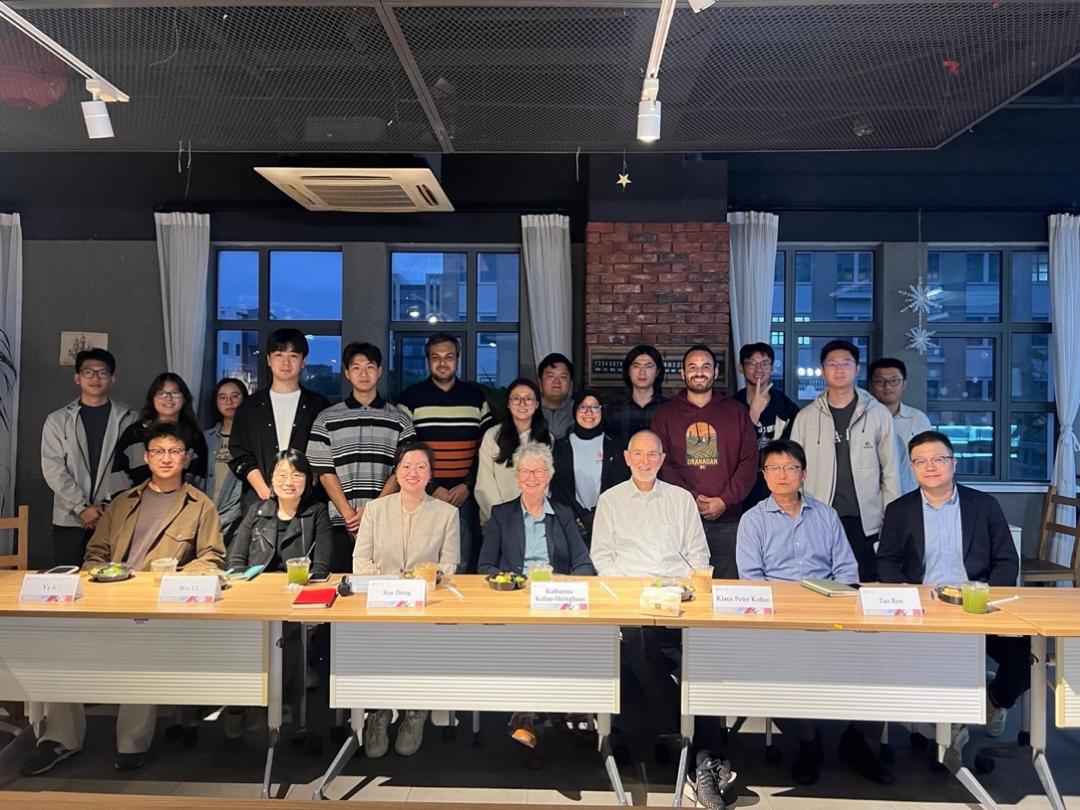
A very rich discussion, forcing us to think of things we commonly overlook on a daily basis
Helena's hope for the year is clear: to move from understanding the “what” of sustainable energy to mastering the “how” of designing it, transforming her ambitious ideas into a scientifically rigorous, innovative, and genuinely impactful research plan.
We at LCC are proud to support Helena’s visionary approach, which merges high-stakes safety expertise with cutting-edge sustainable design. We look forward to the tangible impact her work on the circular bio-economy and green hydrogen will have on industry and our shared global future.
2026-09-11
