


 News
News

 News
News
At Shanghai Jiao Tong University’s China-UK Low Carbon College (LCC), the pursuit of sustainable innovation is driven by engineers with a deep connection to environmental stewardship.
.jpeg)
Among them is Cristhian D. Chicaiza Ortiz “Cris”, a PhD candidate in Environmental Science and Engineering who hails from Ecuador. Cristhian arrived at LCC with a mission to propose alternatives in the transformation of residues into valuable resources. His program now involves working across both the Lingang and Minhang campuses, where he has access to specialized laboratories in.
From Biotech Labs to Global Climate Studies
Cristhian first moved to China to pursue his first Master’s degree in Environmental Engineering at Tianjin University (graduating in 2019), where he worked on a comparative assessment of waste management technologies, including incineration and gasification. This work led to a publication in the Journal of Cleaner Production and deepened his interest in how different technological pathways influence air quality, emissions and long-term sustainability. Seeking to expand this technical foundation, Cris later completed a second Master’s degree in Climate Change, Development, and Sustainability at the Andean University Simón Bolívar in Ecuador.
.jpeg)
Invited speaker at the “SDGs and Innovation Youth Summit – University College London China Forum” (July-2024 Sustainable Development Youth Innovation & Debate – Overseas), held at the Hangzhou.
Along the way, he has also taken part in competitive and state-sponsored research projects. He received support from the Ecuadorian Corporation for Research and Academic Development (CEDIA) and has contributed to a Key Project of the Hubei Provincial Department of Education. Recognized through several competitive scholarships, he was also awarded a China Scholarship Council (CSC) scholarship, which provided key support for his studies in China. Cristhian also participated in a fellowship and internship program with the Environmental Defense Fund (EDF) in Shanghai, where he and Wang Chunping contributed to an energy and water use diagnosis for a multinational company producing vehicle components.

Introducing laboratory activities at the LCC guiding students in their ongoing research on anaerobic digestion and low-carbon technologies.
Cris remained closely linked to academia, teaching in graduate programs at universities such as the Regional Amazonian University Ikiam, the Amazon State University, ESPOCH and the University of Cuenca. He sees his own path as a reference point for those looking to pursue research careers, particularly those in Latin America. He reflects: “My wish is that some of them will advance beyond my achievements and that my experiences can become a useful reference rather than an exception.”
.jpeg)
Cristhian and his students from the master’s program in Environmental and Energy Hydraulics (Ikiam) during a technical field visit to a hydropower facility in Cuenca-Ecuador.
This experience fueled his passion for his current research and convinced him that a PhD was a vital step to refining the tools needed to design effective solutions. As he puts it, “When managed thoughtfully, organic waste has the potential to create jobs, bolster local economies, produce renewable energy, and significantly reduce greenhouse gas emissions.”
Frontier Research on Waste Management
Now, Cristhian’s PhD work focuses on using anaerobic digestion to produce energy and bio-based products from organic waste. His research is framed within the broader field of waste-to-energy and organic waste valorization, an area that is gaining increasing importance worldwide as cities and regions seek to reduce greenhouse gas emissions and move toward circular economy models .
More specifically, he studies how the combined use of CO₂ injection, biochar and zero-valent iron (ZVI) can enhance anaerobic digestion of organic waste. By focusing on the degradation of key macromolecules (proteins, lipids and carbohydrates) and on stabilizing pH and redox conditions inside the digesters, his experiments aim to improve electron transfer pathways and increase methane production, while also generating digestate that can serve as substitutes for synthetic fertilizers.
.png)
Participation in the China–Latin America Economic and Trade Cooperation Think Tank Forum at the Shanghai Academy of Social Sciences (SASS).
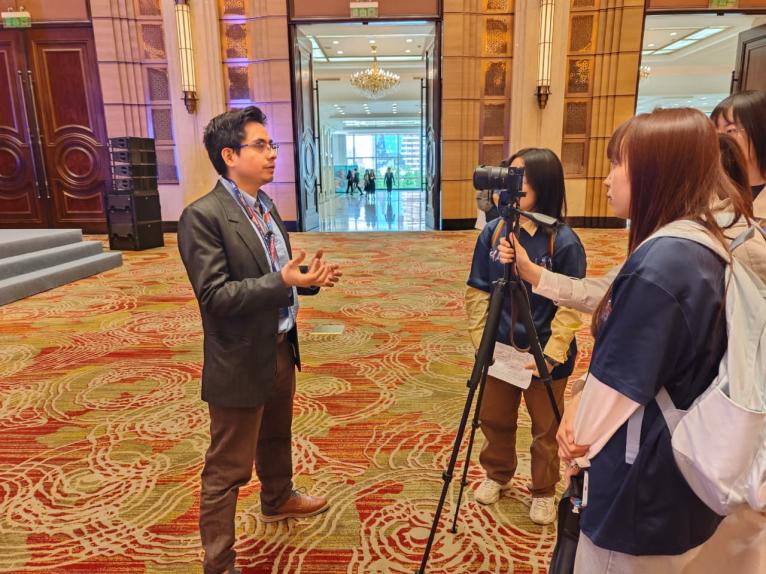
Interviewed during the Shanghai Forum 2025, sharing perspectives on South–South cooperation, sustainable development and the role of young researchers in shaping future partnerships.
His ultimate goal is to develop robust and replicable process configurations that can be adapted to different local contexts, where organic waste management presents a critical challenge. Cristhian notes that his work aligns with global trends toward integrated solid waste management and low-carbon energy systems, and that countries such as Singapore and several Nordic nations already offer valuable examples of how advanced organic waste recovery can be implemented in practice. Cristhian adds, “I genuinely hope that this blend of perspectives will be valuable not just for my research but also for the institutions and communities that may find these explanations helpful in the future.”
His dedication to research has led to contributions in multiple SCI-indexed articles , including publications in Bioresource Technology and Carbon Neutrality, and participation in state-funded projects in both countries.
Why LCC?
Cristhian chose Shanghai Jiao Tong University (SJTU) and LCC because of their strong interdisciplinary focus, their combination of international experience and solid experimental facilities. At LCC, he carries out his work under the supervision of Associate Professor Zhang Jingxin, with whom he holds regular progress meetings to discuss experiments, data analysis and manuscripts. Professor Zhang ensures a balance between providing scientific direction and giving Cristhian the autonomy necessary for growth.

At the “Green for Life” International Graduate Summer School hosted by the LCC supporting a group of students working on new technologies.
The learning environment at LCC is highly international and collaborative. Students come from diverse academic and cultural backgrounds, which enriches classroom discussions and research seminars. Access to laboratories and equipment at both Lingang and Minhang allows Cristhian to conduct experimental work in environmental science, bioenergy and water treatment, while remaining closely connected to broader debates on climate and development. In his view, this makes LCC an attractive place for students from many regions who want to work on low-carbon solutions with global relevance.
Life, Culture, and Connecting Continents
A typical day for Cristhian involves time in the laboratory assessing anaerobic digesters or preparing new experimental runs, scientific reading and writing. In the evenings, he may go to the gym, swim or study Chinese, which helps him to maintain both physical and mental balance. For him, this routine, while demanding, is also deeply meaningful.
Beyond campus life, Cristhian is strongly committed to building academic and scientific bridges between Latin America and China. He serves as president of the Ecuador–China Academic Innovation and Cooperation Network (REDICEC) , where he has had the opportunity to invite professors from LCC and other institutions to present their research projects and participate in joint activities. Through REDICEC, he works to create spaces for dialogue, training and collaboration that make it easier for students, researchers and professionals from different countries to engage in shared projects.

Promoting REDICEC’s initiatives at Ecuadorian universities together with distinguished network members, among them alumni of top institutions like Tsinghua University who are now serve as faculty in Ecuador.
To balance this demanding agenda, Cristhian also enjoys swimming, cycling and hiking, as well as visiting museums and natural attractions. He describes watching the sunrise at Yellow Mountain and walking among the sandstone pillars of Zhangjiajie as moments of peace, discovery and connection that have reshaped how he sees the world. He sees these two powerful landscapes as a metaphor for his current stage of life, reflecting on a personal level how this period has been demanding yet full of discovery, connection and moments that reshape his worldview: “Those two landscapes, different yet equally powerful, reflect what this stage of my life has been: demanding at times, but full of discovery, connection, and moments that reshape how I see the world.”
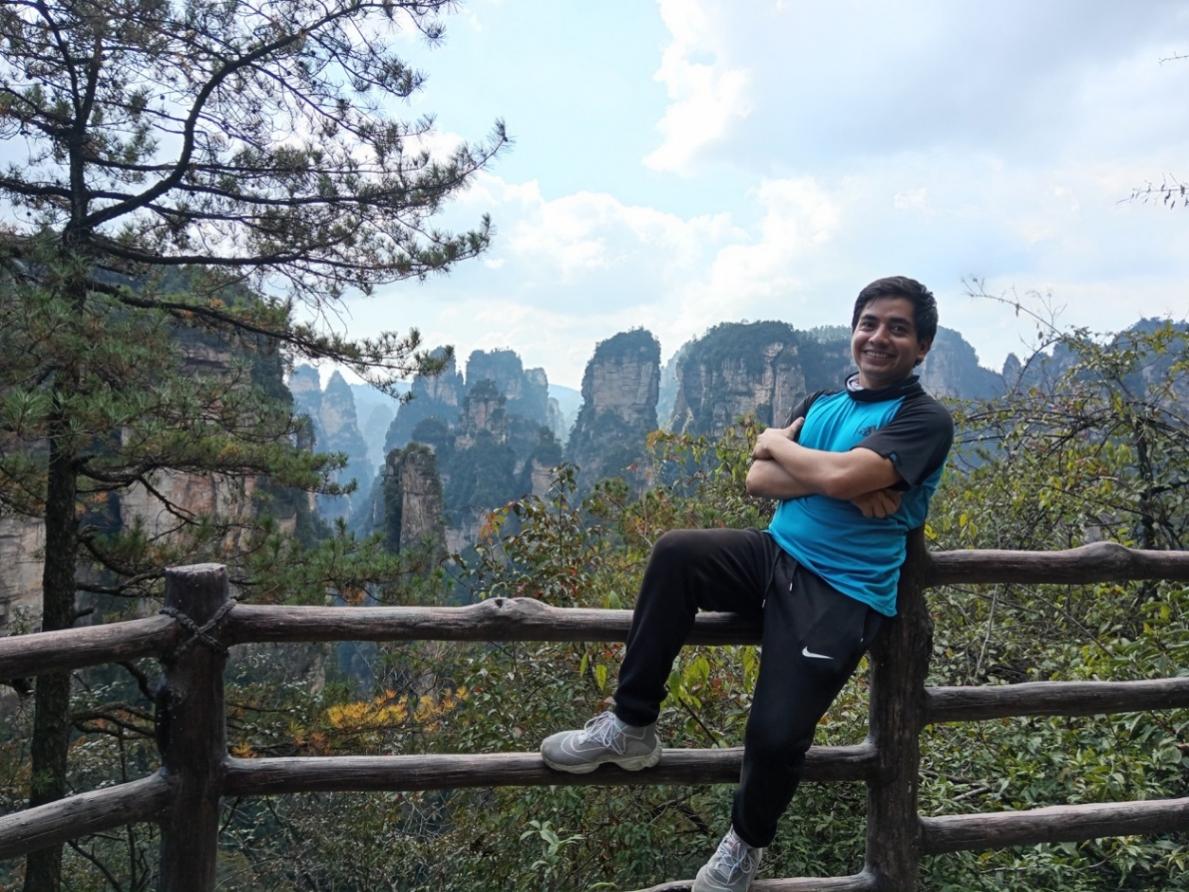
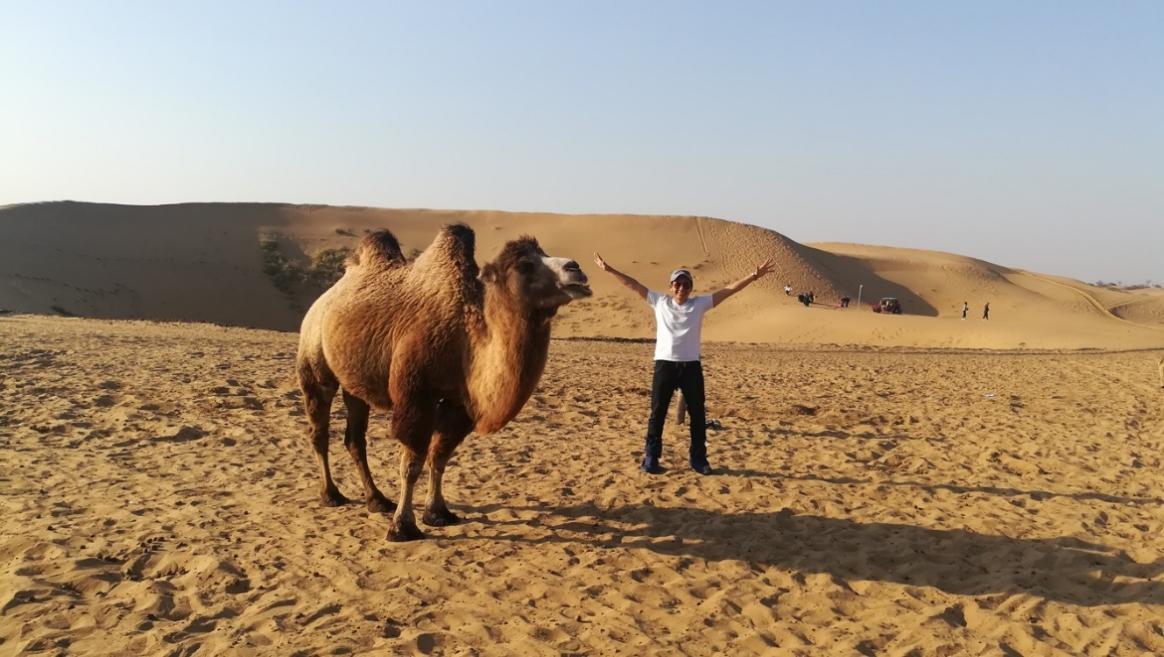
Some of his most memorable trips in China have taken him to places such as Zhangjiajie National Forest Park and the Gobi Desert area in Inner Mongolia.
As he approaches the final year of his program, Cristhian’s primary goal is to complete his PhD and explore opportunities that bridge science and practical applications. He is also eager to deepen collaboration between Chinese and Ecuadorian universities.
We at LCC are proud to support Cristhian’s vital research into waste-to-energy systems. His commitment to blending technical rigor with a global development perspective is exactly the kind of leadership needed to accelerate the circular economy in addressing global challenges.
2026-09-11
